Spider Web Lane
I am Graham, and I can help you or your child overcome dyslexia, dyscalculia, ADD/ADHD and Dyscalculia using the Davis Method.
There are two generally accepted forms of thinking: verbal and non-verbal. People with dyslexia, dyscalculia, and ADHD tend to think non-verbally, using mentally generated sensory impressions such as visual, tactile, and auditory. They are imaginative, creative, empathic and try to solve problems by looking at the whole picture, rather than working step-by-step.
Neurodivergent individuals often experience distortions in perception, but these problems are caused by a mental disorientation. It’s not a problem with eyes or ears, but rather the way that the brain interprets the input from the sensory organs. This is called picture-thinking.
Disorientation is often the source of many strengths and talents associated with neurodivergent/picture-thinking, e.g. creativity, innovative out-of-the-box thinking, empathy, creative problem-solving, etc.
Davis is a programme of exercises that resolves disorientation with picture-thinking clients.
My Dyslexia programme runs between one and six hours a week up to thirty hours in total, plus six hours of additional support as the reader works their way through a list of trigger words.
My sessions can last from 1 hour to six hours, depending on the client’s availability. I try to be as flexible as I can, with sessions in the evenings and weekends.
Every programme begins with an initial meeting and an assessment that tells me which programme I should be doing. The client will see a difference after their first meeting when they are given their Davis tools and use them for the first time.
I do a short reading for an orientation exercise, where the reader gets to practise orientation.
Sessions are held in my family home in Llantwit Major or on Zoom.
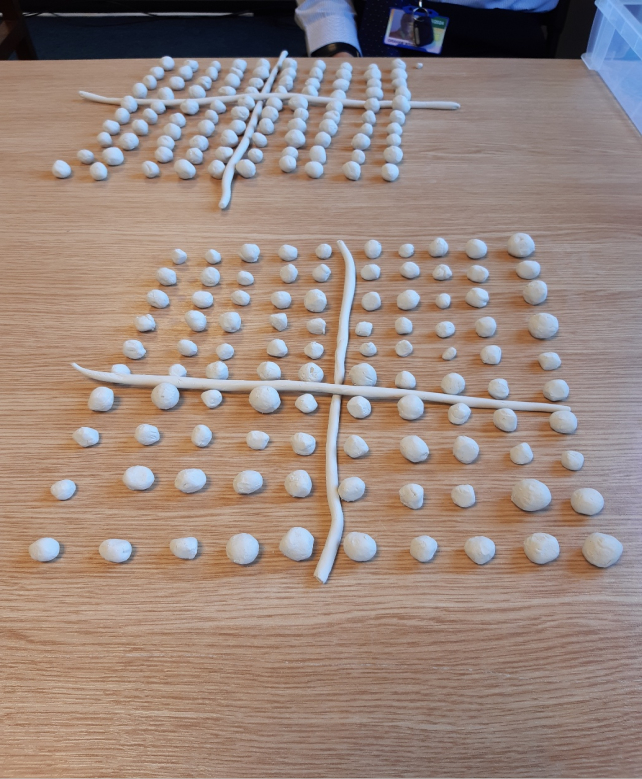
As part of my practice, I use clay models to bring letters, words and numbers into the picture-thinker’s real world, where their meaning becomes a part of the learner rather than being memorised.
I have been a Davis facilitator for 3 years, and I have worked with adults and children.
With children, it is useful to have an adult present because the parent or guardian can learn the procedures, and can then keep up the practice sessions when I am not there. This is why I am a facilitator and not a teacher. In the end, it is up to the child or adult to use their Davis toolkit to help themselves.
I have an Enhanced DBS with Davis, which includes all the information in a standard check, plus any additional relevant information held by local police forces.
My Clients
I have taken RAF engineering students, close to being exited from their training to completion of their training courses, some who were dyslexic and some who were dyscalculic.
An 11-year-old girl, when I first met her and couldn’t read at all to passing her GCSE’s, going on to complete her first year in college, as a mechanic and is now in her second year.
I had one young lad who was dyslexic and dyscalculic, he also had attention problems and his Mum and I saw a significant change in his reading and attitude towards school, he is doing well in secondary school now with his reading.
I am working with an eight-year-old now who is improving her reading skills as the weeks go by, and I am in the middle of teaching her how to tell the time.
I have a client whose goal is to read a book by the pool when she is on holiday. Like everyone else does.
Other Neurodiversities where I can help
Dyspraxia
Davis is a programme that can be used to solve other neurodiverse problems. Resolving disorientation can be a matter of resolving problems with balance and coordination. I have had one client who had symptoms associated with dyspraxia and I was able to work with him to help him be less clumsy. I have also witnessed clumsy dyslexic clients become less clumsy as they practise with Koosh balls and orient their mind’s ear along with their mind’s eye.
ADD/ADHD
The Davis programme is also effective in controlling the symptoms of ADD/ADHD.
A feature of ADD/ADHD is a lack of understanding concepts that help make one human being tolerant of another (being quiet in a library, for example). A person whose lack of attention causes them to miss or misunderstand important community lifestyle ideas will suffer.
A Davis ADD/ADHD programme introduces concepts as clay models, which are mastered and become a part of the person, so they can go on and live as they want to.
Dyscalculia
Picture-thinkers can be oriented when reading, but be disoriented when they see numbers and symbols in maths. Maths problems are solved using the same concepts that may be missing in the ADD/ADHD mind. Numbers are approached in a similar way to the letters of the Dyslexic programme.
Dysgraphia
A picture-thinker can be a messy writer. This happens when messages are distorting what they see. A dysgraphia problem is usually an additional part of a programme that is only identified after the initial assessment is carried out.
Generally ...
The thing to remember about all these different programmes is that none of my clients stop being Dyslexic, Dyspraxic, ADD/ADHD, or Dyscalulic.
They are given a set of Davis tools and are facilitated in using these tools when they choose to use them. The originator of the Davis Method - Ron Davis - never wanted to take away the beauty of our different people; he just wanted them to know that they could take control when they chose to.
His first book was called The Gift of Dyslexia, because it is a gift, and many people have used their gift to make this world what it is today.
A place where we can all live together.
Prices
About Me
I am 62 and married, a father of two children, with an extended family of two further children. I have 7 grandchildren with 1 more on the way.
I am a triathlete training for half and full iron man distances.
I love solving problems and enjoy using my mind to help others with their maths. I am a cleaner, elder and part time preacher at my local Presbyterian Chapel.